Share This

Showing posts with label scammers. Show all posts

Friday, 5 December 2025

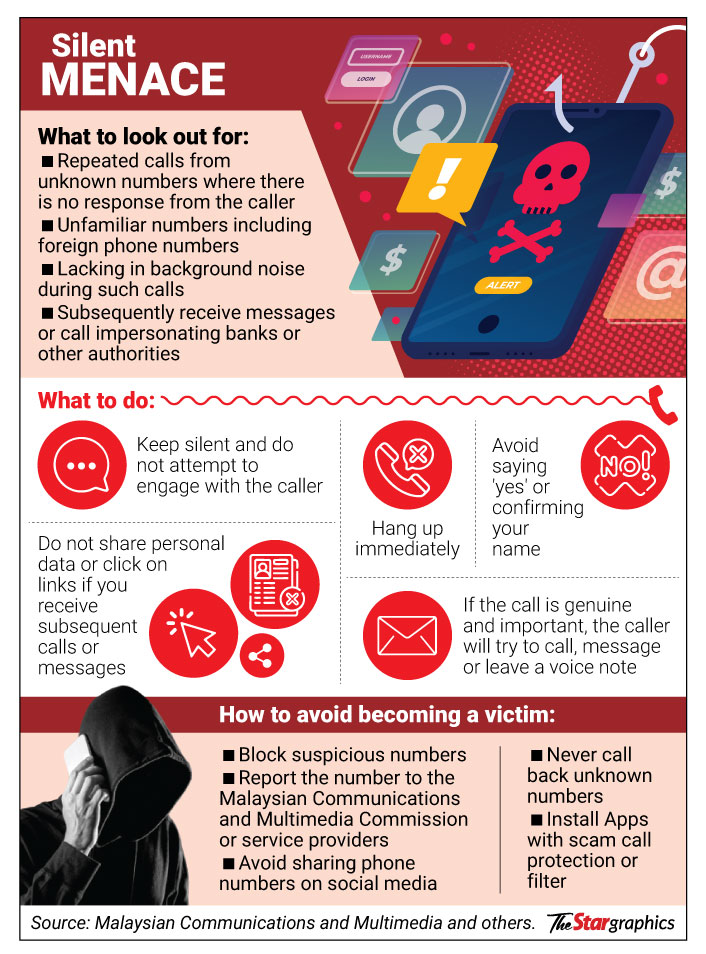
Silence is golden in new call scam


This visual is human-created, AI-aided.

AI used to gather sound metadata to clone voices

PETALING JAYA: Silence is golden. This is exactly what one should do to avoid becoming a victim of the latest AI-generated silent call scam, says the Malaysian Communications and Multimedia Commission (MCMC).

A recent video released by Friends of MCMC warning of the latest tactic used by scammers saw several Malaysians coming forward to relate their personal experiences.

Sean Ang, 34, a data analyst from Kuala Lumpur, said he grew suspicious of phone calls from unknown numbers recently.

ALSO READ: Stay smart and be suspicious of scammers

“The calls would come in but there would be no one speaking on the other side.

“Fortunately, I was aware of the latest scam and had also read about how scammers are using AI to dupe people in Thailand.

ALSO READ: Chasing easy money leaves victims with big losses

“When I get such calls from unknown numbers, I will remain silent and hang up if no one is on the other end,” he said when contacted yesterday.

Sabahan Francis Magawun, 43, currently working in Petaling Jaya, said he received calls from unknown local mobile numbers and overseas phone numbers.

“I am a sceptical person by nature and wary of getting unknown calls even before the recent warning issued by the MCMC.

CLICK TO ENLARGECLICK TO ENLARGE

“If I get such calls, I remain silent to see if there is any response before hanging up,” he said.

Magawun is concerned that senior citizens may fall prey to such scams as they are not aware of evolving online threats, particularly those using AI technology.

The silent call is a tactic used by scammers to phish for victims. It begins with ringing up the target, but the caller deliberately leaves the line silent when the call is answered.

By answering, a person is deemed to have an active number and is placed on a target list for scam messages or calls impersonating banks or other authorities.

If the target answers, his voice is recorded and later cloned with AI for impersonation purposes.

The MCMC had recently posted a two-minute video on social media to warn Malaysians that AI technology is being used to gather sound metadata to clone voices.

The AI-cloned voice is then used to scam the target’s family by requesting help due to an emergency, to get a company staff member to transfer money or to by-pass voice verification used by certain commercial institutions.

Mohamed Hussain Rasool Mohd became more alert after reading a warning posted on the Penang Community Facebook page of such modus operandi.

Kaizen Sun, in a posting in the same Facebook page, said those who answered a silent call would usually get follow-up calls the very same day and for the next several days.

“All sorts of numbers – local, mobile and international.

“There was even one WhatsApp text message telling me that he was my long-lost contact from wine trading (and I’m wondering in which lifetime was I involved in the alcohol business),” the post read.

Related stories:

Related News


Tuesday, 11 March 2025

Is your tenant a criminal?


Click To Enlarge)


KUALA LUMPUR: Property owners will have to be much more careful about who they rent to, following the announcement last week that the police will hold landlords responsible for crimes committed on their premises.

To help, the police have identified several red flags which owners should look out for when putting their premises up for rent.

“Be wary of those who pay large sums for advance payments and deposits,” Comm Datuk Seri Ramli Mohamed Yoosuf told The Star.

“Criminals, especially scammers, have paid up to six, or even 10 months’ rent in advance for condominium units. In some cases, there are scammers who purchase properties in cash.”

The Bukit Aman Commercial Crime Investigation Department (CCID) director said landlords, joint management bodies (JMB) of high rises, and security companies should also watch out for large groups of people staying in one property.

“If a condominium unit has 20 to 30 people staying there and they are rarely seen, that is deemed suspicious,” he said.

“Frequent changes in occupants will also occur, as well as ordering food from ehailing services and having lookouts posted in the lobby in case the authorities raid the premises.

“These are the telltale signs of premises being used by criminals, especially scam syndicates.”

ALSO NREAD: Experts: Focus on criminals, don’t ‘victimise’ landlords

He added that landlords, JMBs, and security companies can no longer claim ignorance if criminal activities occur on their properties or, in the case of security companies, on premises they have been hired to guard.

“We are really serious about focusing on holding such parties liable if criminal activities, especially scam call centres, occur on their properties.

“As I mentioned previously, we will take action against them under Section 120B of the Penal Code for criminal conspiracy. No longer are actions solely focused on syndicate members,” he said.

In this context, Comm Ramli said the CCID is also proposing amendments for Section 108 of the Penal Code for abetment (aiding an offender committing a crime).

(Click To Enlarge)(Click To Enlarge)

“While we can still take action under existing laws, the proposed amendments will give the police more jurisdictive power to further investigate owners of premises in connection with illegal activities occurring on their properties.

“We will also propose heavier penalties, including forfeiture of properties. We expect to submit the proposals to the Home Min­ister soon,” he said.

Following major crackdowns in Myanmar and Cambodia, scam syndicates are beginning to shift their call centres to other countries, including Malaysia.

This is why holding property owners, as well as security companies and JMBs, liable is vital, Comm Ramli said.

“Using the relevant laws will be a form of deterrent, making the three parties accountable, and in turn, reducing the number of scam call centres in the country,” he said.

ALSO READ: Urgent need for long-awaited residential tenancy law

Universiti Sains Malaysia criminologist Datuk Dr P. Sundra­moorthy said landlords have various methods to evaluate whether potential tenants might pose a risk during the tenancy period.

“Landlords can implement evaluation thorough screening procedures, such as conducting background checks and verifying employment and rental history,” he added.

Sundramoorthy said landlords can also check references from previous landlords.

They should also assess the tenant’s financial stability and observe their behaviour and interactions, he said.

In addition, being vigilant about local crime patterns and staying informed through community reports can help landlords identify potential risks too.

The senior criminologist said homeowners and landlords can take proactive measures such as installing security cameras, good lighting and secure entry systems.

“They can also foster a sense of community among tenants by encouraging communication and reporting suspicious activity,” he said.

Malaysians Against Rape, Assault and Snatch Theft (Marah) founder Dave Avran concurred with Sundramoorthy, saying that landlords have a duty to conduct proper background checks and ensure their properties aren’t being used for illegal purposes.

“Too often, scammers set up operations in rented homes or office spaces with little to no oversight.

“If landlords faced penalties, they would be more cautious about whom they rent to, thus reducing the likelihood of such incidents,” he said.

In some cases, property owners knowingly turn a blind eye, he added.

“Critics point to landlords who ignore red flags like tenants paying in cash, frequently changing occupants, or restricting access to parts of the property,” he said.


Urgent need for long-awaited residential tenancy law


PETALING JAYA: Following the announcement last week by the police that they could hold landlords responsible for illegal activities carried out on their property, it is now more urgent than ever that the long-awaited Residential Tenancy Act (RTA) be tabled, say stakeholders.

Malaysian Institute of Estate Agents president Tan Kian Aun said the Act should be expedited to address the rising cases of property-related scams, illegal activities, and landlord-tenant disputes.

“We’ve received a lot of complaints, not only from the public but also from real estate agents.

“Landlords are discovering that their units are being used for illegal activities such as online scams, illegal call centres, and even gambling – often only after neighbours complain or the tenants stop paying rent,” he said when contacted.

He shared a case in which a landlord only discovered that his condominium unit had been turned into an illegal call centre when the electricity bill skyrocketed and neighbours complained of suspicious activity.

“The tenant had passed all checks and even paid a six-month deposit. But when they stopped answering calls, we found the place rigged with wiring and computer set-ups, all hidden from plain view.

“Most landlords only realise what’s happening when the rent stops coming in or the police knock on their door,” he said.

Kian Aun said one essential provision of the proposed RTA should be to grant landlords the right to inspect their properties.

“You cannot put all of the blame on landlords. But landlords must also take responsibility.

“If we allow inspections, at least the owner or their agent can verify that the unit is being used properly,” Kian Aun said.

Housing and Local Government Minister Nga Kor Ming recently said the ministry is still drafting the RTA, which aims to regulate landlord-tenant relationships and ensure that both parties are given their rights and fulfil their obligations throughout the tenancy.

Senior lawyer Marcus Tan Kian Han, managing partner of Marcus Tan & Co, said property owners and joint management bodies (JMBs) should not be held fully accountable for illegal activities carried out by tenants unless there are clear laws or regulations in place.

“Whether it is fair and reasonable to impose such duties and obligations on property owners and JMBs depends on whether there are existing laws or regulations which, at the moment, there are none,” he said.

“In the absence of legislation requiring property owners to take such measures, it may not be truly fair and reasonable. It becomes more of a matter of common sense rather than a legal duty.”

In the absence of clear laws, Marcus suggested that property owners take proactive measures to protect themselves, such as verifying and keeping copies of tenants’ identification documents like identity cards, passports, or company registration papers.

He said owners should conduct background checks using available databases like the Credit Tip-Off Service or insolvency portals, and even conduct basic online searches to identify any possible red flags.

He also advised owners to seek tenants’ written consent to carry out comprehensive background searches that could reveal litigation history, and to include a clause in tenancy agreements that allows owners to inspect the property under reasonable notice, as well as indemnity clauses to protect themselves.

Marcus recommended that owners engage solicitors to draft stronger tenancy agreements and to use professional tools such as Handshake or public databases, including sanctions or wanted lists, to perform deeper checks on potential tenants.

He said JMBs should require landlords to submit copies of tenants’ identity documents and tenancy agreements for record-keeping and security purposes.

He added that JMBs should immediately notify landlords if security guards detect any suspicious or illegal activities, and they should pay attention to tenants who share access cards or to visitors not listed in the records provided by the landlord.

He said that without clear policies or regulations, both property owners and JMBs remain vulnerable to being implicated in criminal activities carried out by tenants and that firm guidelines are necessary to provide clarity and protection for all parties involved.


Related stories:


Thursday, 5 September 2024

Your first line of defence, tracking scams: National Scam Response Centre (NSRC), 997 hotline, National Fraud Portal (NFP), emakMule portal


Boosting efficiency: A woman reading about the NFP, which is poised to greatly enhance the process of scam reporting and fund tracing. — AZHAR MAHFOF/The Star


CLICK TO ENLARGE

The platform’s ability to centralise and standardise fraud reporting across play its part and stay vigilant against scammers, say police

Public must play its part and stay vigilant against scammers, say police

KUALA LUMPUR: Check before your click, say the police.

Bukit Aman Commercial Crime Investigation Department (CCID) director Comm Datuk Seri Ramli Mohamed Yoosuf has urged the public to use the SemakMule portal (https://semakmule.rmp.gov.my/) before making any financial transaction online.

“Use the SemakMule portal to verify and check the list of mule bank accounts, phone numbers and shell companies used by scammers.

“The portal was established in 2020 to list phone numbers and mule bank accounts, but it has since been improved to (include) the names of shell companies,” he told The Star yesterday.

Comm Ramli said that so far, a total of 216,074 mule accounts have been listed on the site along with 178,006 phone numbers used by scammers.

“We also listed a total of 3,904 shell companies used by scammers,” he added. 

Some 27 million visitors have logged in to the portal since its inception, and about one million of the searches have been positive, meaning transactions made to mule accounts were prevented.

Comm Ramli hopes that the public would be able to fully utilise the improved SemakMule portal to prevent from getting scammed.

“We will never relent in our enforcement efforts against scam syndicates, but we hope the public can play its part by staying vigilant,” he said.

Comm Ramli said scammers are coming up with new modus operandi to dupe victims into giving them their money, including using generative artificial intelligence to produce fake videos, as well as audio and text messages.

“Scammers are resorting to new and innovative ways to dupe victims. We have encountered cases recently in which scammers used deepfake technology to mimic the voice of a victim’s friend to dupe them.

“Use the SemakMule portal to prevent being scammed. The public can also report any scam to the National Scam Response Centre (NSRC) by calling the 997 hotline,” he added.

According to Comm Ramli, other methods used by scammers include advertising dubious investment schemes on social media and phone scams, where scammers call up victims posing as officers from government agencies.

Meanwhile, on the establishment of the National Fraud Portal (NFP), Comm Ramli said it was a good anti-scam effort.

“We welcome the NFP, especially when it can further enhance the role of the NSRC in detecting scams faster, (enabling us) to help the victims.

“It will certainly boost the fight against scams,” he said.

Comm Ramli also hopes that financial institutions will be able to fully utilise the NFP, to enhance security measures.

“It (NFP) is a step in the right direction but at the same time, we urge banks and other financial institutions to upgrade their security, both internally and externally against any threat be it malware or ransomware.

“We also hope they will be able to better secure the data of their customers as well,” he said.

This year alone, over RM1.6bil in losses have been recorded from commercial crimes, including scams, Comm Ramli noted.

Source link 

Related stories: NFP to help tackle fraud and recover stolen funds Tracking scams made easy Imposters crying wolf preying on victims in M’sia, S’pore Seremban among districts with highest fraud cases Woman loses RM30,000 in phone scam involving bogus cops

Your first line of defence, tracking scams: National Scam Response Centre (NSRC), 997 hotline, National Fraud Portal (NFP), emakMule portal


Boosting efficiency: A woman reading about the NFP, which is poised to greatly enhance the process of scam reporting and fund tracing. — AZHAR MAHFOF/The Star


CLICK TO ENLARGE

The platform’s ability to centralise and standardise fraud reporting across play its part and stay vigilant against scammers, say police

Public must play its part and stay vigilant against scammers, say police

KUALA LUMPUR: Check before your click, say the police.

Bukit Aman Commercial Crime Investigation Department (CCID) director Comm Datuk Seri Ramli Mohamed Yoosuf has urged the public to use the SemakMule portal (https://semakmule.rmp.gov.my/) before making any financial transaction online.

“Use the SemakMule portal to verify and check the list of mule bank accounts, phone numbers and shell companies used by scammers.

“The portal was established in 2020 to list phone numbers and mule bank accounts, but it has since been improved to (include) the names of shell companies,” he told The Star yesterday.

Comm Ramli said that so far, a total of 216,074 mule accounts have been listed on the site along with 178,006 phone numbers used by scammers.

“We also listed a total of 3,904 shell companies used by scammers,” he added. 

Some 27 million visitors have logged in to the portal since its inception, and about one million of the searches have been positive, meaning transactions made to mule accounts were prevented.

Comm Ramli hopes that the public would be able to fully utilise the improved SemakMule portal to prevent from getting scammed.

“We will never relent in our enforcement efforts against scam syndicates, but we hope the public can play its part by staying vigilant,” he said.

Comm Ramli said scammers are coming up with new modus operandi to dupe victims into giving them their money, including using generative artificial intelligence to produce fake videos, as well as audio and text messages.

“Scammers are resorting to new and innovative ways to dupe victims. We have encountered cases recently in which scammers used deepfake technology to mimic the voice of a victim’s friend to dupe them.

“Use the SemakMule portal to prevent being scammed. The public can also report any scam to the National Scam Response Centre (NSRC) by calling the 997 hotline,” he added.

According to Comm Ramli, other methods used by scammers include advertising dubious investment schemes on social media and phone scams, where scammers call up victims posing as officers from government agencies.

Meanwhile, on the establishment of the National Fraud Portal (NFP), Comm Ramli said it was a good anti-scam effort.

“We welcome the NFP, especially when it can further enhance the role of the NSRC in detecting scams faster, (enabling us) to help the victims.

“It will certainly boost the fight against scams,” he said.

Comm Ramli also hopes that financial institutions will be able to fully utilise the NFP, to enhance security measures.

“It (NFP) is a step in the right direction but at the same time, we urge banks and other financial institutions to upgrade their security, both internally and externally against any threat be it malware or ransomware.

“We also hope they will be able to better secure the data of their customers as well,” he said.

This year alone, over RM1.6bil in losses have been recorded from commercial crimes, including scams, Comm Ramli noted.

Source link 

Related stories: NFP to help tackle fraud and recover stolen funds Tracking scams made easy Imposters crying wolf preying on victims in M’sia, S’pore Seremban among districts with highest fraud cases Woman loses RM30,000 in phone scam involving bogus cops

Tuesday, 2 August 2022

Scammers getting smarter now and so should we


Scammers keep getting bolder and bolder with their extortion methods. From impersonating landlords to illegal debt collection tactics, there is no shortage of ways scammers will try to separate you from your money. Be aware of these five red flags when getting on the phone, checking your email, or using social media. This can help you avoid getting trapped in a conversation with a scammer in the first place.


Whether it’s through email, text, phone calls or direct messages, scams seem to be everywhere on the internet. Not all scams are obvious and many specifically target small business owners. Learn how to recognize a scam, protect your business and know what to do if you become a victim of a scam.


Being forearmed with knowledge is key to not falling prey to well-trained scammers

 Arm yourself with knowledge to identify a swindler

RIGHT before my eyes, I witnessed my friend falling for a classic Macau scam over the phone.

The call from a “government official” had him hooked. Frantically, I gestured to my friend to end the call but he was like a man possessed.

Someone on the other end of the line, claiming to be a government official, informed my worried friend that he had been implicated in a crime of sorts and the only way to escape the consequences was to transfer his money into a “safe account”.

After 45 minutes on the phone, he sent RM5,000 to one such bank account, and this happened on his pay day!

Recalling the incident, my friend said the caller was so convincing and believable that it was hard to cut the line.

This incident came to mind when the long arm of the law finally caught up with Tedy Teow, the founder of MBI (Mobility Beyond Imagination) well-known for its superlative money-making scheme.

He was detained in Thailand about a week ago and is believed to be wanted for questioning over several money-laundering cases in a few countries.

From what I could tell, the news failed to generate much interest on the ground, especially in Penang where the scheme used to have a large number of followers.

It could be that many of his victims were resigned to the fact that their money was as good as gone, even though Teow got arrested.

I have many acquaintances who put money into MBI. A few earned some returns. Most did not.

Now, it is “successful” Macau scams that are dominating the chatter in coffeeshops, offices, watering holes and messaging groups.

Indeed, teachers, engineers, doctors and even a politician were among the prized scalps of these so-called officers from banks or government and law enforcement agencies.

In May, a businessman from Port Dickson with a net worth of over Rm100mil lost a record Rm21mil in one such scam after he allegedly revealed his bank Transaction Authorisation Code (TAC) numbers to a “bank official”.

A sizeable number of scam victims were retirees who lost their hard-earned savings.

As pointed out in one news report, these scammers actually go through a month-long boot camp conducted by professional trainers before they are sent out for con jobs.

Psychology, negotiation skills, the art of persuasion, they learn it all.

They go through gauntlets of role-playing, with one being the “victim” and the other the scam caller, all under the watchful eyes of the trainers.

It has become challenging these days for lawmen to outfox the syndicates which have members even sitting for exams before being certified competent enough to man scam call centres.

And now we hear of increasing cases of dubious bank transfers: money being unknowingly transferred out of savings and fixed deposit accounts after victims were said to have downloaded phone apps.

Protect yourself by not downloading apps from dubious sites!

Then there are the online lovers to whom the lonely give their money even though they have never met face to face.

For those not in the know, this actually happens gradually.

First, the amounts asked for are small. These are quickly returned with a small but appreciable profit. Only after trust is established will the scammer ask for the big amounts.

The situation has never been more urgent as there are still victims who fall prey to such tactics almost on a daily basis.

If you get a call from a scammer, stay calm and rightfully hesitate when asked to reveal your personal banking and user login details.

In the course of a true fraud investigation, government and law enforcement agencies will not transfer calls among themselves. Bank Negara will not transfer your calls to Bukit Aman and vice versa, and never call back the number that was given.

Remember, the police will never threaten to arrest you over the phone; they prefer to do it face to face.

And if it’s a pre-recorded message, just hang up.

Most importantly, if you are a law-abiding citizen who has done nothing wrong, there is indeed nothing to fear. 

By TAN SIN CHOW

sctan@star.com.my
              
 
Related posts:
 
CLICK TO ENLARGE Entrepreneur, philanthropist, get-rich-quick ‘hero’ wanted in M’sia and China He lorde
 

Tuesday, 22 June 2021

Be advised of checking first, not to fall victim to love or parcel scam thru social media


BALIK PULAU: If you fall in love with someone on social media and that someone needs financial help and gives you bank account numbers to send money to, there is one way to check if you might be ensnared in a love scam.

“The public is advised to check the account numbers through the Royal Malaysia Police’s Commercial Crime Investigation Department website  (https://ccid.rmp.gov.my/semakmule) or download the Check Scammers CCID app through Google Play before making transactions,” said Balik Pulau OCPD Supt Kamarul Rizal Jenal.

You can also key in your online lover’s telephone number to check if the number was used to dupe anyone.

The checking system is available in English, Bahasa Malaysia, Chinese and Tamil.

Supt Kamarul urged the public to always be careful and not fall victim to love or parcel scam syndicates through social media.

He gave this advice after a 47-year-old businesswoman here became RM74,000 poorer after sending money to her “American boyfriend” whom she had met on social media.

The woman came to her senses and lodged a police report on Thursday night.

“The victim met the suspect on Facebook in April.

“The suspect claimed to be from the United States and experiencing a financial crisis related to an excavation project in Italy.

“He told the victim he needed money to repair the site of the excavation project.

“The victim, who had known the suspect for just a month, believed him and transferred RM74,000 through seven transactions to two local bank accounts provided by the suspect.

“The victim finally realised that she was scammed after telling a friend about the incident.

“She found out that the suspect’s profile pictures were used on several fake Facebook accounts and lodged a police report,” Supt Kamarul said in a statement yesterday.

The case will be investigated under Section 420 of the Penal Code for cheating.

Source link  

Related  posts:

Here’s how Macau scammers conned Malaysians out of RM256mil this year

Johor Coronation


Watch out for WhatsApp scammers


WhatsApp Tips: How to clear WhatsApp cache when you are running low on phone memory


Hello, Penang police calling ... Macau Scammers reap RM2.7mil 


Taiwan telecom fraud suspects repatriated from Malaysia and Kenya


How to outsmart smartphone scammers ?


Top spammers and scammers in Malaysia by anti-spam mobile app Truecaller


Here’s how Macau scammers conned Malaysians out of RM256mil this year 


Johor Coronation